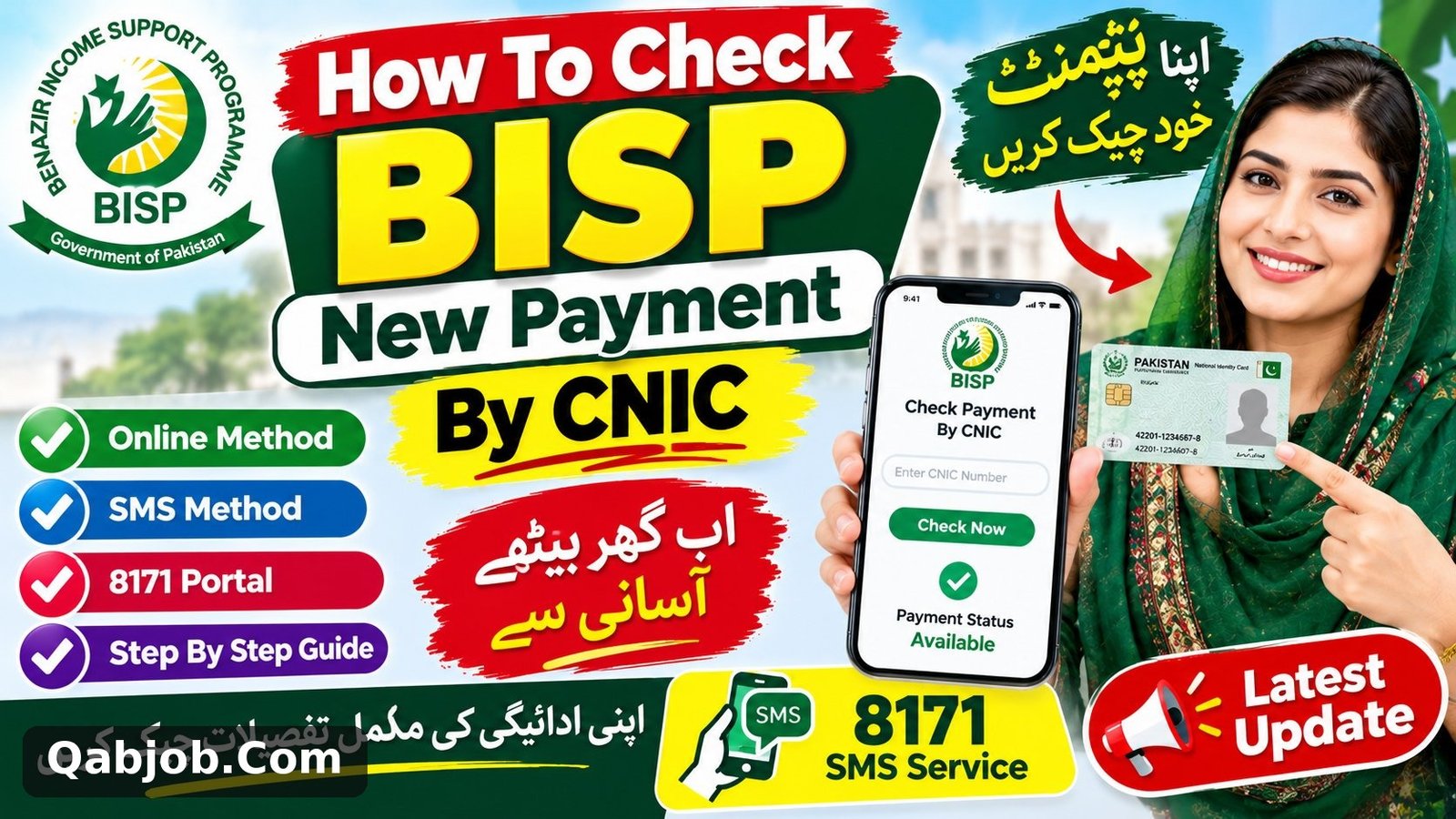
A BISP payment does not travel in a straight line from Islamabad to your hand. It moves through stages — a status check, an eligibility record, a payment generated against your name, a district-wise release, and finally a verified collection — and most of the anxiety beneficiaries feel comes from not knowing which stage they are standing in. This guide walks the whole journey in order, so at any moment you can locate yourself on the path and know what happens next.
Stage 1: The Check That Starts Everything
Every journey begins with one of two official checks, both completely free.
The 8171 web portal. Open 8171.bisp.gov.pk, enter your 13-digit CNIC number with no dashes or spaces, type the captcha code shown on screen, and submit. The portal reads your record and returns your status.
The SMS route. From your mobile, send your 13-digit CNIC number — again, digits only, no dashes — as an SMS to 8171, and wait for the official reply.
These are the only two channels BISP uses for status checks. There is no official app to install, no WhatsApp number, and no agent in the chain. Checking costs nothing beyond a normal SMS charge, and nobody can check “better” than you can yourself.
Stage 2: Reading Your Status Like a Milestone, Not a Verdict
Your result tells you which stage of the journey you are in:
- Eligible / payment ready: your record is approved and a payment exists against your CNIC. Your remaining journey is about the release phase and collection.
- Under verification: your data is still being checked. This is a waiting stage, not a rejection. Recheck after some days rather than daily.
- Survey or record update required: your household information needs to be registered or refreshed, which means a visit to the BISP tehsil office for the dynamic registry process. No payment journey continues until this stage is cleared.
- Not eligible: your current record does not qualify under the programme’s criteria. If your circumstances have genuinely changed, the registry at the BISP office is the route to have your record reviewed — not any intermediary.
Stage 3: The Phase Release — Why the Whole Country Is Not Paid on One Day
The current Benazir Kafalat installment is Rs 14,500 for the October–December 2026 quarter, and it is deliberately not released everywhere at once. Payments open phase-wise, district group by district group, so that payment points, biometric devices and banking channels are not overwhelmed on a single day.
This stage explains the most common false alarm in the whole journey: your status shows a payment, your relative in the next district has collected hers, and your local payment point says “not yet.” All three things can be true at the same time. Your district’s phase simply has not opened. The correct action is to wait for your phase and recheck — money already shown against your CNIC is not lost because a neighbouring district was scheduled first.
Stage 4: Collection Day, Walked Through
When your phase is live, collection itself is a short, set routine:
- Carry the essentials: your original CNIC, and the mobile phone with the SIM registered in your name where possible. Photocopies and other people’s cards do not complete biometric payment.
- Go to the designated payment point for your area — the authorised campsite, retailer or banking channel announced for the current phase.
- Biometric verification: your thumb impression is matched against your NADRA record. This step is the lock that keeps the payment yours; it is also why nobody else can collect on your behalf.
- Receive and count the full amount before you leave the counter. The full installment is Rs 14,500. No deduction — for checking, for “processing,” for the shopkeeper — is authorised at any point.
- Take the receipt or confirmation and keep it until the next quarter. If anything is disputed later, that paper is your proof.
Stage 5: When Biometrics or Records Refuse to Cooperate
Two problems interrupt Stage 4 more than any others, and both have official exits.
Fingerprint mismatch. Worn fingerprints — common among women who do manual work — can fail the scanner. Do not keep pressing the same thumb indefinitely or pay anyone who offers a “setting.” The remedies run through official channels: verification alternatives at the payment point as per the staff’s procedure, updating your biometric record at NADRA if the prints on file are the problem, and guidance from the BISP office where the issue persists.
Expired or outdated CNIC. An expired card can block verification. Renew it at NADRA first; your payment record follows your CNIC number, so renewing the card does not erase your entitlement — it unblocks it.
In both cases, the free BISP helpline 0800-26477 exists precisely for beneficiaries stuck mid-journey. Call it before paying any self-appointed fixer.
A Small Habit That Smooths Every Quarter: Your Own Payment Record
Beneficiaries who move through this journey calmly share one habit: they keep a simple record of it. Note the date you checked your status and what it said, the date your district’s phase opened, the date and place you collected, and the amount received. Keep the collection receipt with these notes, along with a photocopy of your CNIC. This little file takes two minutes per quarter and pays for itself the first time anything is disputed — a short payment, a missed quarter, a record error — because you walk into the BISP office or call the helpline with dates and proof instead of memories. Programmes run on records; the beneficiary who keeps her own is never at a disadvantage.
The Fraud That Waits at Every Stage
Notice the shape of the journey: at no stage does money change hands except the final one, where it moves from the counter to you. That is why every fraud in the BISP landscape tries to insert a fake stage — a fee to “release” a payment, a charge to “check” a status, an OTP someone needs from your phone, a deduction at the counter described as compulsory. Each one is invented. Checking is free, releasing is automatic by phase, and deductions are unauthorised; a deduction taken from you can and should be reported on 0800-26477 with the payment point’s details.
Frequently Asked Questions (FAQ)
Q1: My status shows a payment but my district phase has not started. Should I complain?
Not yet — a generated payment and an open phase are two different stages, and the gap between them is normal scheduling. Wait for your district’s phase announcement and recheck your status. If your phase has clearly opened and others at your payment point are being served while your record still blocks you, that is the moment for the helpline or the tehsil office.
Q2: Can my son or husband collect the payment for me?
No. Collection requires the beneficiary’s own biometric thumb verification, so the registered woman must attend herself. Anyone offering to collect “on your behalf” through some arrangement is describing something the system is specifically built to prevent.
Q3: My thumb failed at two different shops. What is the actual next step?
Persistent failure points to the fingerprint record, not the shops. Visit NADRA to have your biometrics refreshed if advised, and inform the BISP tehsil office of the difficulty — beneficiary facilitation for biometric issues runs through these official desks, and the helpline can tell you the current procedure for your case.
Q4: I moved to a different district after registration. Where do I collect?
Your record is tied to your registered information. Collect through the channels for your area as directed by your status and local announcements, and update your record at the BISP office so future quarters reflect your current district. Do not start a second registration — one CNIC holds one record.
Q5: What documents should I take if my status says a survey is required?
Carry your original CNIC and the family’s basic documents the office asks for — typically the CNICs of adult family members and children’s B-Forms — and attend the dynamic registry desk at the BISP tehsil office yourself. The survey is free; nobody outside the office is authorised to conduct or sell it.
Conclusion
Seen as a journey, a BISP payment stops being mysterious: check free on the portal or by SMS, read your status as a milestone, wait for your district’s phase, collect the full Rs 14,500 in person with biometric verification, and solve biometric or record problems through NADRA, the BISP office or the helpline on 0800-26477. Every shortcut offered along the way is a toll booth that does not exist. Walk past it.